


NEws
News and updates from Jubilee Foodbank Market Harborough:
Challenging the Myths Around Food Banks
Jubilee Foodbank Market Harborough is on a mission to tackle hunger and challenge the myths around food banks. We’re an independent charity, we never share personal details, and we provide support without judgement.
Food poverty is something many people still find difficult to talk about - and unfortunately, misconceptions about food banks still exist.
The truth is, no one expects to need a food bank.
People referred to us are parents trying to feed their children, older people choosing between heating and eating, homeless people, workers whose wages no longer stretch far enough, and individuals facing sudden crises such as illness, bereavement, relationship breakdown, or delays to benefits.
Many have never needed support before.
Behind every food parcel is someone doing their best to cope with circumstances that are often unexpected and overwhelming. It’s important not to make assumptions about people’s situations or judge experiences we may never have faced ourselves. Here are some of the most common myths we hear:
“Food banks are only for unemployed people”
Many people who use food banks are actually in employment. Low wages, insecure contracts, reduced hours, and rising living costs mean that having a job does not always provide financial security.
“People just need to budget better”
Most households accessing food banks have already cut back as much as possible. Food bank use is often triggered by situations outside someone’s control - illness, benefit delays, family breakdown, bereavement, or unexpected bills. They are an emergency option - not a regular replacement for a weekly shop. By monitoring usage, we can sometimes identify patterns and help signpost people to the right support to address the underlying issue and reduce recurrent need.
“Benefits cover basic living costs”
The ongoing cost of living crisis continues to place huge pressure on households, with food prices, fuel costs, and energy bills all rising sharply. Universal Credit, Personal Independence Payment (PIP), and other benefits simply no longer cover the real cost of essentials, leaving families struggling to get by.
“People become dependent on food banks”
Food banks are designed to provide short-term emergency support during periods of crisis. Most people only need help temporarily while they recover from illness, wait for payments, or stabilise their finances. We see the bigger picture and proactively signpost to alternative support networks available including StepChange Debt Charity, Citizens Advice Bureau, Healthy Start schemes, and more. By taking this approach, we aim to help people, not just in the moment of crisis - but towards longer-term stability wherever possible.
“People use food banks because the food is free”
Using a food bank is rarely an easy decision. As we do not yet have our own premises, we are unable to offer a “shop-style” experience where people can choose their own items. Instead, we provide essential food parcels based on what has been donated. We hope to move towards a more flexible model in the future, but for now this is not possible without suitable premises.
For many people, asking for help can come with feelings of embarrassment or shame. Food banks exist because no one should have to go hungry during difficult times.
“Food poverty only affects certain people”
Food insecurity can affect anyone. A change in health, employment, housing costs, or family circumstances can rapidly place people under severe financial pressure. It is far more common than many people realise. Here, in Market Harborough, it seems we are in an affluent community - but 2025 marked the busiest year in Jubilee Foodbank’s 13-year history. We received 1,310 referrals leading to support for 1,877 adults and 1,442 children - and almost 70,000 meals provided to local people in need.
“Donations aren’t really needed”
Demand for support continues to rise, and every donation genuinely matters. April 2026 was our busiest month so far this year, with over 90 households supported and more than 6,000 meals provided thanks to the generosity of our local community.
Food, funds, and volunteer time all help ensure we can continue supporting local people with dignity and care when they need it most. Over Harvest Festival and Christmas, we receive very welcome bulk collections, but in summer, during school holidays - which is often a peak time for demand - the collections drop off so we reach into our reserves and regularly shop to restock the shelves.
Growing gaps in public services are placing greater pressure on charities, leading to increased reliance on food banks and voluntary organisations for essential support, including social care, mental health, legal and financial advice, and addiction services.
Behind these pressures are real people and real lives, which is why it matters to challenge the assumptions often made about food bank use.
By confronting stereotypes and choosing compassion over judgement, we can help reduce the stigma around needing support. Hardship can happen to anyone. Food insecurity can be closer than many realise - often just a few unexpected life events away from any of us.
At Jubilee Foodbank, we believe everyone deserves to be treated with dignity, respect, and understanding.
Thank you for continuing to support our work and helping us care for people across our community.
Please find the following links to some important further reading:
Guarantee our Essentials
Trussell Trust
Government report
July 2026
Jubilee Foodbank Calls for Urgent Action Over Record-Breaking Demand
Jubilee Foodbank Market Harborough is calling on all parties to take urgent action to better support families and individuals struggling to make ends meet, as figures show 2025 was the busiest year in the charity’s 13-year history.
Jubilee Foodbank saw 1,310 referrals - the highest number ever recorded. This demand translated into unprecedented levels of support needed, locally - with:
-
1,877 adults helped
-
1,442 children supported
-
69,699 meals provided
“These figures are not just statistics—they represent real people in our community who are struggling to afford to eat,” said Liz Mills, MBE, Chair of Jubilee Foodbank Market Harborough. “No one should have to rely on emergency food support to survive in one of the world’s wealthiest countries.”
Jubilee Foodbank Market Harborough has identified many reasons for people seeking help. These include:
-
A lack of comprehensive support for families and individuals, including accessible, in-person services
-
Increased energy and utilities bills and council tax, which usually increase collectively annually, in April, and which continue to place enormous pressure on household budgets
-
Increased costs on many basic items resulting in a need for a recalculation of the true cost of living to ensure Universal Credit, Personal Independence Payment (PIP), and the State Pension reflect real-world costs. The Joseph Rowntree Foundation’s Cost of Living Tracker and the Commons Library offer more information
-
An increased expectation for charities to fill gaps leading to an over reliance on food banks and other charities for universal basic needs, such as social services, mental health support, legal and financial advice, and addiction services
“Food banks should not be part of the long-term safety net,” Liz Mills adds. “They were never meant to replace adequate incomes, affordable energy, and properly funded public services. Our goal is not to grow, but to become unnecessary.
"Harborough is seen as an affluent, middle-class area, but there clearly remains a real and often hidden need for food bank support."
Jubilee Foodbank Market Harborough Board of Trustees said in a joint statement "Food insecurity can affect anyone, and sudden life changes — including job loss, relationship breakdown, ill health or mental wellbeing challenges — can push people into difficulty rapidly, and through no fault of their own. It is vital that the community continue to work together to support those who might otherwise slip through the net.
"People are overlooked when systems, services or even communities do not recognise someone’s need in time. In practice, this often affects people who do not meet strict eligibility criteria, who are unsure where to turn for help, or who are coping with sudden changes or crises in their lives. Others may feel overwhelmed, isolated or reluctant to seek support, meaning their need remains hidden until they reach a point of real hardship, or worse.
"Often someone reaching out to a food bank has had multiple compounding life events that result in them struggling to make ends meet. Illness or caring for a family member can upturn a carefully planned budget. Furthermore, for over a decade, cuts and increased costs have led to people struggling to maintain the basics such as food, hygiene items and energy."
Already receiving high demand and multiple referrals in the first weeks of 2026, Jubilee Foodbank Market Harborough will continue to support those struggling with food insecurity. Signposting to other support streams and networks available - while advocating for long-term solutions that give stability and hope to all.
February 2026
About us
In 2012, members of The Congregational Church Market Harborough launched an initiative to support those facing food poverty. It started with just a few parcels each month.
They now receive around 100 referrals from individuals and families each month. They also provide signposting to other support available, both locally and nationally.
Jubilee Foodbank Market Harborough is run completely by unpaid volunteers, and currently has around 65 active volunteers; made up of trustees, front line volunteers, store team, collections team, shoppers and administrators.
Stay in touch:
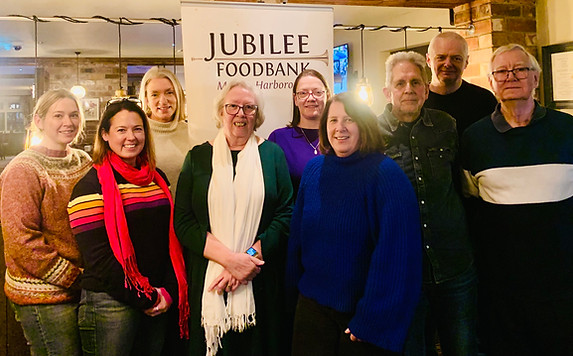
Members of the Jubilee Foodbank Board of Trustees, joined by Board Secretary
and Food Store Manager, at The Roebuck in Market Harborough, 2026